How it works
On this page
What happens between Http.Get and the TResponse you get back.
A request, end to end
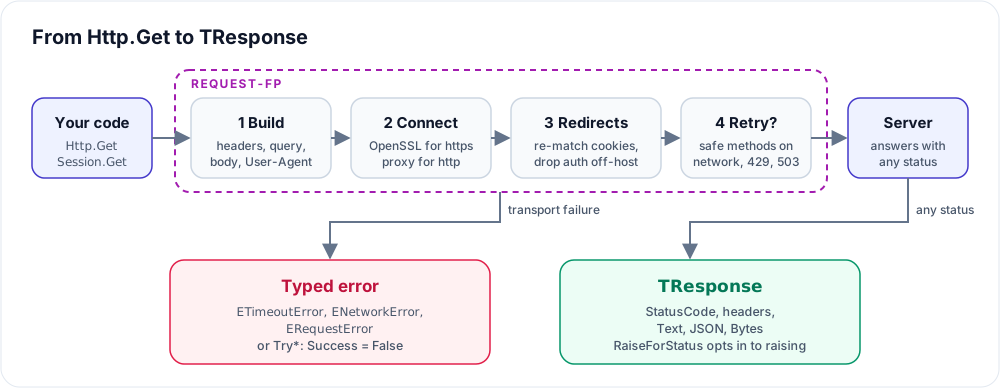
- Build. Headers, query parameters, and the body are prepared. A
User-Agentis added unless you set one. - Connect.
https://URLs load OpenSSL on first use.http://URLs go through a proxy when one is set. - Follow redirects. Cookies are re-matched for each new URL, and
Authorizationis dropped if the redirect leaves the host. - Retry if it is safe. See below.
- Return. Any HTTP status becomes a
TResponse. A transport failure raisesETimeoutError,ENetworkError, orERequestError, or fillsTRequestResultforTry*methods.
Records with management operators free everything automatically: there is no client object to free, and Response.JSON is owned by the response.
Retries
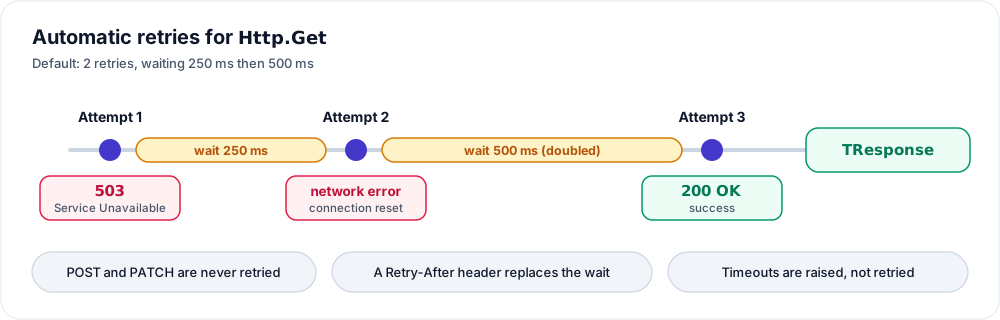
- Only GET, HEAD, PUT, and DELETE are retried. These are safe to repeat; POST and PATCH could create or change something twice.
- Retried: network errors,
429 Too Many Requests,503 Service Unavailable. Not retried: timeouts, other statuses. - Waits double each time: 250 ms, then 500 ms by default.
Retry-Afterreplaces the wait. If it is longer than the timeout, the response is returned straight away so your code can decide.- A download is not retried once bytes have been written.
Change it with Http.SetRetry(Count, FirstDelayMS); SetRetry(0, 0) turns it off.
Cookies and redirects in a session
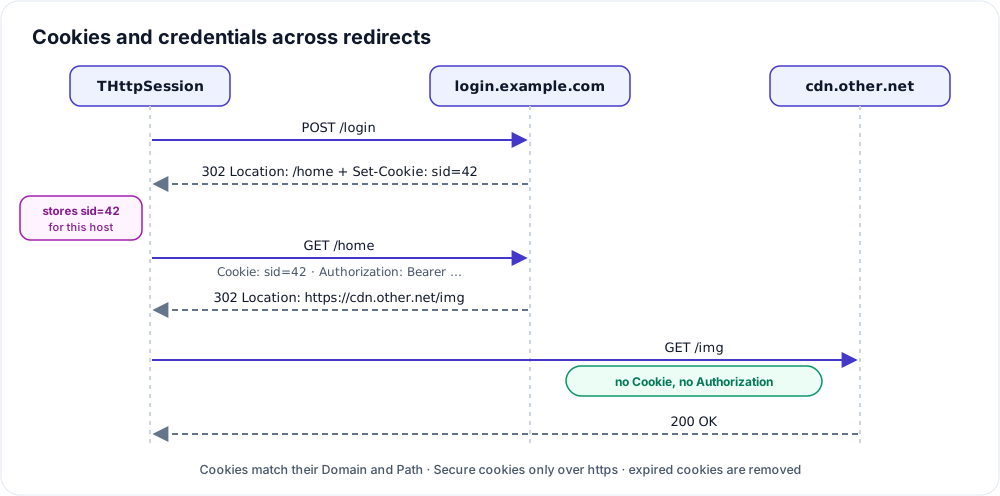
Set-Cookieheaders on redirect responses are kept, so a login that answers with a redirect still logs you in.- Each cookie remembers its
DomainandPathand is only sent where they match.Securecookies go over HTTPS only. Expired cookies are removed. - When a redirect moves to another host, the session’s own cookies and the
Authorizationheader stay behind.
Streaming downloads
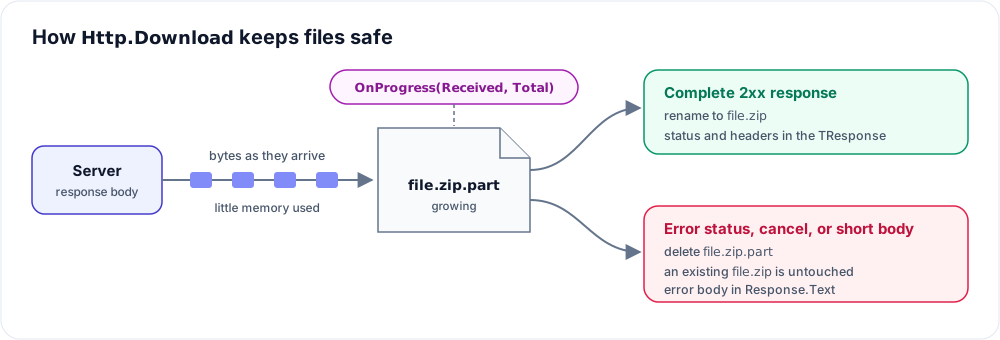
- The body is written as it arrives, so a 4 GB file needs little memory.
- Bytes go to
file.part. Only a complete 2xx response renames it to the real name, so an existing file is never half-overwritten. - Error statuses leave the file alone and put the error body in
Response.Text. - A body shorter than
Content-LengthraisesENetworkError; FPC alone would accept it silently. - Raising an exception in the progress callback cancels the download.
Uploads work the same way in reverse: PostMultipart reads each file from disk while sending.
Errors
Exception
└── ERequestError        any Request-FP failure
    └── ENetworkError    connection, DNS, socket, TLS, server closed early
        └── ETimeoutError connect timeout or I/O timeout
Catch the most specific class first. HTTP error statuses are not exceptions unless you call Response.RaiseForStatus.
See Technical details for FPC and OpenSSL internals.